


Mob Control
VOODOO
I went into Mob Control expecting a quick arcade distraction, and that is exactly where it makes its strongest impression. The basic idea is easy to understand: I guide a stream of small characters through gates, try to increase the size of my crowd, and push toward a battlefield objective. The appeal is immediate because the action is readable within seconds, yet every gate choice can change how successful a run feels.
Developed by VOODOO, this free arcade game is built for short sessions rather than long explanations. I can pick it up while waiting for a bus, play a few rounds, and put it down without feeling as if I have abandoned a complicated story. That simplicity is also the reason it has reached over 100 million installs and earned a 4.2 average from around 804 thousand ratings. Those figures suggest broad appeal, but they do not remove the need to understand what kind of player will actually enjoy its loop.
Why the first few rounds work so well
The opening experience is driven by quick visual feedback. My crowd moves forward, the gates present an obvious decision, and the result is shown almost immediately. A gate that multiplies the group feels rewarding because I can see the advantage grow in real time. A poor choice is equally clear: the crowd becomes smaller, and the final push loses force.
I like that the game does not bury this central interaction under a large tutorial. The learning curve comes from watching the lanes and recognizing which option is likely to produce the better result. This makes it approachable for younger players as well as adults who want something uncomplicated. The Everyone age rating fits that accessible presentation.
The first impression is not about deep strategy in the traditional sense. It is about timing, lane selection, and the satisfaction of turning a modest group into a visibly larger one. That distinction matters. If you want a detailed arcade campaign with complex controls, this will feel light. If you want a game that communicates its objective without demanding concentration for an entire evening, it is much more convincing.
Related News

Why WhatsApp Messenger Still Makes Everyday Communication Feel Easy

Jurassic World: The Game Is the Better Dino Tycoon for Strategic Players

Threads in Real Life: Who Should Join, Lurk, or Leave

How SHEIN Turned Shopping Into an Endless Content Feed

How to Make Fortnite Feel Smarter on Mobile

Should You Switch to Microsoft Outlook on Mobile?
One useful habit I developed was to stop treating every gate as an automatic “choose the biggest number” moment. The best-looking option is not always the best practical option when the crowd is approaching an obstacle or a narrow route. I started looking at the next part of the path before committing, which gave the simple controls more tension than I expected.
The game also benefits from the fact that failure is easy to understand. When a run goes badly, I usually know whether I chose the wrong lane, reacted too late, or entered the final confrontation with too small a group. That clarity makes another attempt feel reasonable instead of frustrating. There is little mystery about what I should change.
A visual language built around motion
The art direction uses a clean, toy-like presentation that keeps the crowd readable while it moves. Characters are small and stylized, but their numbers are the important visual message. I do not need to inspect individual faces or detailed scenery to understand what is happening. The group itself becomes the main visual object, expanding, compressing, and colliding with the opposing force.
Gallery
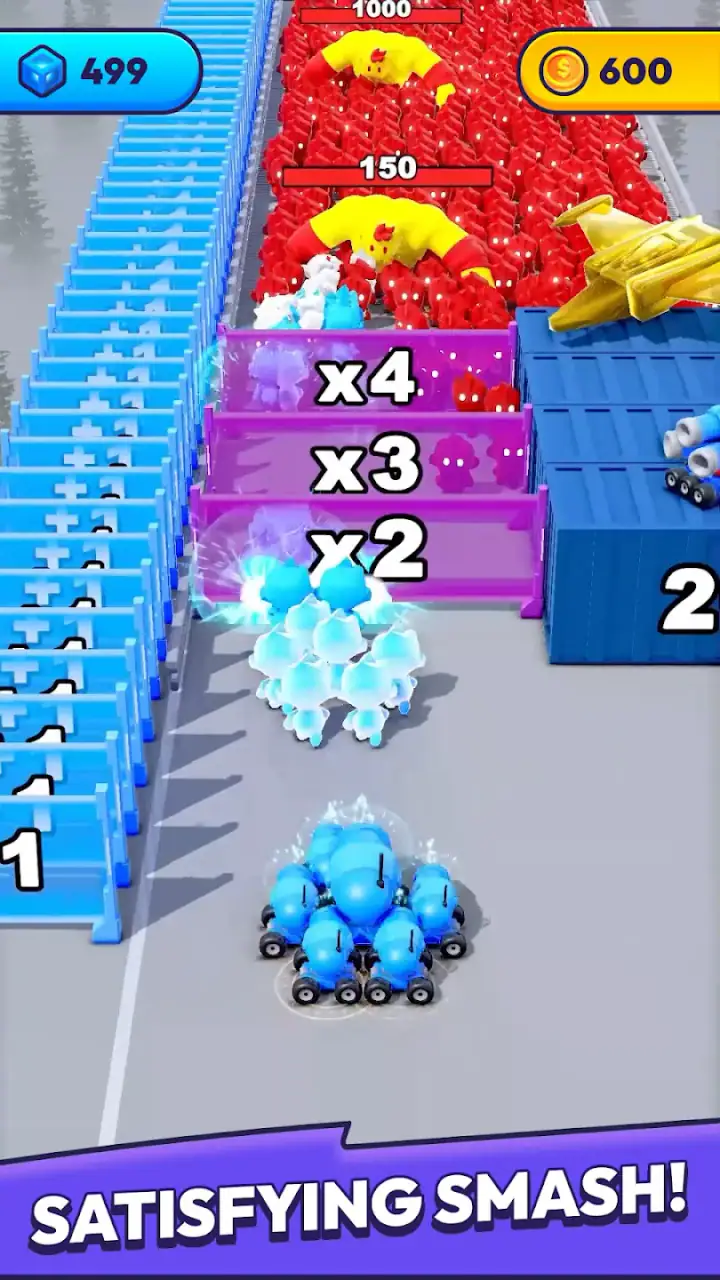
That choice gives the game a coherent identity. The battlefield is not presented as a realistic military location; it feels more like a bright, abstract obstacle course where color, shape, and movement explain the rules. The setting exists to frame the crowd’s journey and the final contest, rather than distract me with lore or environmental detail.
I found this especially helpful on a small phone screen. A busy interface could make the gates and lanes difficult to read, but the uncluttered look keeps the decision area prominent. The art is doing functional work, not merely decorating the action. When the crowd grows, the visual change is instantly noticeable, which reinforces the reward without requiring a text explanation.
The same visual simplicity can become repetitive over longer sessions. Because the game’s identity depends so heavily on moving groups and gate choices, players looking for constantly changing scenery may eventually want a different arcade experience. I would not call that a flaw in execution; it is a trade-off created by the game’s focused design.
Another detail I appreciated is how the scale of the crowd creates its own sense of progress. Even without a complex character system, I can feel a run improving because the screen becomes more crowded and the final push looks more confident. That is a smart use of visual feedback: the game turns quantity into a readable emotional signal.
Sound, rhythm, and the feel of a run
The sound design supports the game’s quick rhythm rather than trying to dominate it. Movement through the gates, the growth of the group, and the clash at the end all work as parts of a short audiovisual sequence. The result is a mood that feels energetic and playful, which suits the bright presentation better than a serious or dramatic soundtrack would.
What matters most is the relationship between sound and pacing. A run has a clear rise: I begin with a smaller group, make decisions as the crowd advances, and reach a more intense conclusion when the two sides meet. The audio helps those stages feel connected. It gives the session a beginning, buildup, and payoff even though the individual round is compact.
I would still recommend using headphones selectively. This is a game I can enjoy with sound on when I want extra energy, but it also works as a quiet background activity when I am in a public place. The visual clarity means I am not dependent on audio cues to understand the main decisions. That flexibility is valuable for a mobile game designed around brief, repeatable sessions.
The rhythm also explains why the game can be more absorbing than its rules suggest. There is always a small question in front of me: which route will preserve or increase the crowd, and will that advantage matter by the time I reach the confrontation? The sound and movement keep that question feeling immediate instead of turning it into a slow calculation.
At the same time, the fast loop can encourage automatic play. After several rounds, I sometimes found myself selecting a gate too quickly because the pattern felt familiar. My best results came when I deliberately paused for a moment to read the full route. That is an important practical tip: the game rewards quick reactions, but not mindless ones.
Where the mechanics fit—and where they do not
At its core, Mob Control is an arcade game about crowd management through simple choices. I steer the flow indirectly by selecting routes and gates, then watch the consequences unfold. The control scheme is approachable because it does not demand a large set of buttons or complicated gestures. Most of the challenge comes from judgment rather than dexterity.
This makes it a good fit for players who enjoy the immediate satisfaction of casual arcade games but want a little more decision-making than a purely reflex-based title. I am not solving a long puzzle, yet I am also not simply tapping without thought. The strongest moments happen when I compare the short-term increase from one route with the likely position of the crowd later in the run.
One of the game’s subtle strengths is that it turns multiplication into a tactical resource. A larger crowd is not just a score-looking number; it changes how confident the final encounter feels. That creates a useful mental workflow: first, I look for ways to grow; then, I consider whether the route leaves enough of that advantage intact for the finish.
The limitation is that the strategic space remains intentionally narrow. Players who want several character classes, elaborate loadouts, or a large range of tactical commands may find the experience too streamlined. It is better understood as a polished decision loop than as a full strategy game. Comparing it with more traditional arcade alternatives, I would say this offers more planning than a pure endless runner but less mechanical variety than a deeper action title.
The free entry point makes it easy to try, but the in-app purchase range runs from $0.84 to $399.99 per item. That is worth keeping in mind before handing the game to a child or letting a younger player use a payment-enabled device. I would personally begin with the free experience and decide whether the core loop remains enjoyable without spending. The game’s basic appeal should be judged by the crowd-and-gate interaction, not by the assumption that purchases are necessary.
For everyday use, I see two particularly good scenarios. The first is a short break when I want a clear objective and a quick reset between tasks. The second is casual play with someone nearby, where we can compare decisions and laugh at a badly chosen route without needing to commit to a long match. It is less suitable for a commute where I need to stop constantly, because even a short run benefits from keeping attention on the route.
Players may also wonder whether an older phone can handle it. The listed minimum operating system is Android 8.0, so the game is aimed at a broad range of Android devices that meet that requirement. The current version is 3.10.2. I would still keep expectations realistic on very old hardware: a compatible operating system does not automatically guarantee the same smoothness as a newer phone, especially during busy moments.
Another practical question is whether the game is appropriate for children. Its Everyone rating and simple presentation make it approachable, but the purchase range means I would use normal device payment safeguards. The content is easy to understand, yet the repeatable reward loop can encourage “one more round” behavior. For younger players, I would set a clear play limit rather than assuming the short rounds will regulate themselves.
How the atmosphere supports the playable mood
The strongest achievement here is the way presentation and mechanics point in the same direction. The bright visuals make the growing crowd feel playful, the sound gives each run momentum, and the compact structure keeps the mood buoyant. Nothing is trying to turn the experience into something grander than it is. That restraint helps the game remain coherent.
The battlefield setting works because it is abstract enough to keep attention on the crowd. I am not asked to care about a fictional history or a detailed cast. I care about whether the group I have built can get through the route and overpower the opposition. For this particular design, that is enough context to make each run feel purposeful.
Pacing is equally important. The game does not spend a long time preparing the action, and it does not make the conclusion feel disconnected from the choices I made earlier. The final encounter is the payoff for the route, so even a failed attempt gives me a clear reason to try again. This is a better fit for mobile play than a design that hides its reward behind lengthy menus or slow transitions.
Still, the same focus means the atmosphere may not hold every player indefinitely. If I want a strong narrative mood, rich exploration, or a soundtrack that changes dramatically from stage to stage, I would look elsewhere. If I want a colorful, energetic arcade loop in which the visual scale of my crowd tells me how well I am doing, this is much more persuasive.
I also think the game works best when I treat it as a short-form experience instead of trying to grind through it for hours. The repeated structure is satisfying in small doses, but extended sessions can expose the limited range of its central interaction. Taking breaks preserves the sense of momentum and keeps the gate decisions from becoming mechanical habits.
My final take on the experience
Mob Control is a focused arcade game that understands the value of immediate feedback. I can see the goal, make a route choice, watch the crowd change, and reach a conclusion without learning a complicated control system. Its art direction, sound, and pacing create a light, playful mood that supports the mechanics rather than competing with them.
I would recommend it to anyone who enjoys short mobile sessions, visual cause-and-effect, and simple decisions with visible consequences. It is particularly good for players who like the feeling of building momentum from a small starting group. I would be more cautious about recommending it to someone seeking deep strategy, a story-driven setting, or constant mechanical novelty.
The game is free to start, carries an Everyone rating, and comes from VOODOO, but its purchase range deserves adult attention on shared devices. I also would not mistake its accessible controls for a complete lack of thought: the best runs come from reading beyond the next gate and considering how much of the crowd will survive into the final push.
After spending time with it, my honest view is that the atmosphere succeeds because every part of the presentation reinforces the same promise: make a crowd, keep it moving, and enjoy the payoff when it reaches the battlefield. The most important choice is not simply growing the mob; it is growing it in a way that still matters at the finish. That gives this compact arcade title enough personality to stand out, even while its deliberately narrow loop will not suit everyone.
FAQs for Mob Control
What is the main objective of Mob Control?
Mob Control is a strategy-based mobile game where players aim to control a group of characters, guiding them through various levels. The objective is to increase your mob's size while overcoming obstacles and defeating opponents. This is achieved by strategically managing resources and planning your moves to ensure your mob's survival and growth.
How does the gameplay mechanics work in Mob Control?
In Mob Control, players swipe and tap to direct their mob through different paths. The gameplay involves multiplying your mob by directing them through gates that increase numbers, avoiding traps, and strategically engaging with enemy forces. The challenge is to balance growth with resource management to outsmart opponents and win each level.
Is Mob Control suitable for all age groups?
Mob Control is generally suitable for players of most age groups, as it features simple controls and colorful graphics. However, it does involve strategic thinking and decision-making, which may be more engaging for older children and adults. Parents may want to supervise younger children to ensure they understand the game's mechanics.
Are there any in-app purchases or ads in Mob Control?
Yes, Mob Control includes in-app purchases that allow players to enhance their gameplay experience by purchasing additional resources or unlocking premium features. The game also displays ads, which can sometimes be removed or minimized through in-app purchases. Players should be aware of these aspects before downloading.
What are the system requirements for installing Mob Control?
To install Mob Control, your device needs to meet certain system requirements. For Android users, it's recommended to have Android version 5.0 or higher. iOS users should have iOS 10.0 or above. Ensure your device has adequate storage space and a stable internet connection for optimal performance and updates.
Pros
- Intuitive swipe controls make gameplay easy.
- Vibrant graphics enhance user engagement.
- Regular updates introduce new challenges.
- Multiplayer mode adds competitive fun.
- Minimal ads for uninterrupted play.
Cons
- Limited character customization options.
- Occasional lag in multiplayer mode.
- In-app purchases can be pricey.
- Some levels feel repetitive.
- Requires constant internet connection.


